Sylla’s Aromatic Beginnings
This interview was originally published in the Aromatika magazine (11.1. 2024. SPRING)
How did you initially get involved with aromatherapy, and what made you start working with essential oils?
I discovered essential oils in a scent shop in Austin Tx in 1977 and then at local health food stores or co-ops. I started collecting scents and using them for myself as perfume when I noticed people had delightful reactions to my personal patchouli blend, which soon became my signature scent, I still wear today. I soon began adding them to my massage blends. I thought I had invented something before I heard the word aromatherapy! Of course, I was thrilled to get my first copy of the Art of Aromatherapy and realized this is going to be my journey. I began to seek out companies, courses, and other practitioners and aromatherapy became my greatest passion in life.
Where did you start your career?
I have been a Cosmetologist since 1969 and a licensed Massage therapist in 1979. By 1982 I opened a salon called Rumors in Tampa, Florida and offered hair and skin care, aromatic massage and sold my own line of aromatics along with my vintage clothes. During this time, I began teaching small classes and opened the Atlantic Institute of Aromatherapy in 1989. As I began writing my home study course, The Aromatherapy Practitioner Course, I began what became my two volume manuals called The Aromatherapy Practitioner Reference Manual, which is still in print and has helped thousands. I did not set out to write a book as it started as a wall chart. Once it became too big, my husband created the format, and I started using my first computer. After a few years it was finally published, and I went back to updating and finishing the course. The Course itself has been revised over the years with influence by those mentioned below.
What is your first memory about your first contact with essential oils?
I was so fascinated with the variety and chose my favorites to combine as perfumes, but also soon realized the difference in essential oils and synthetics. I remember when I wore certain combinations people would remark about them, this is why I began adding to my massage oils. I soon realized the power they had just on others, on relaxation, and didn’t even understand yet they may have medicinal properties. Once I understood they came from medicinal herbs which I was familiar with, and that they had certain properties, I made many remedies for family and friends.
Who did you study with?
I studied with everyone I could and collaborated with more!
Once I realized that I did not invent this, I wanted to know more. I first took Kurt Schnaubelt’s home study course and began seeking out teachers and colleagues like Emilee Stewart here in Florida. I began looking for oils from true aromatherapy companies, which were few in the eighties. Remember we didn’t have the internet and found supplies or teachers via books, herb, health and massage magazines and mail notices or word of mouth. In 1988 a small group of us formed the first attempt at organizing, the American Aromatherapy Association in California, and that enabled me to find more seminars and resources.
Who was your inspiration or the most influential people, and why?
I never stopped studying until a few years ago so my list is long. My first major inspiration was Martin Watt. Once I had started to create the Atlantic Institute of Aromatherapy and began teaching, I started my book. When I thought I was done I met Martin and he helped me redo my course safety and my book. I in turn published his book Plant Aromatics here in the US and brought him over to do classes.
In 1992 I met Dr. Jim Simon on a trip to the WOCMAP conference in Maastrich, Netherlands. Purdue first offered a 2 week Medicinal and Aromatic course. They then offered a two-part course in essential oils in 1996. These courses helped me understand the science and showed us firsthand cultivation, field distillation, lab work, and more. The second class is where the leaders in aromatherapy, who were in attendance, started thinking we need to organize, because who is certifying the teachers? We formed the Purdue Initiative and then became a Steering Committee to form the Aromatherapy Registration Council that has been testing and awarding the Registered Aromatherapist title for 25 years.
During the first week of the Essential Oil class at Purdue, I met Dr. Rob Pappas during a field trip to the Lucac peppermint still. He and I became fast friends and colleagues, and I dragged him into our discussions. He got involved with the aromatherapists when he started analyzing our oils and showed fraudulent oils. He became our champion over the years, speaking the truth about companies and the oil business. We wrote several papers including: The Essential Oil of Eucalyptus camaldulensis Dehn. From South Florida: A High Cryptone/Low Cineole Eucalyptus, J. Essent. Oil Res., Winter 2000 and “Artemesia- a new high azulene oil from the pacific northwest”, presented with Tony Burfield at First International Phyto-Aromatic Conference, Nice, France (Mar2000). Additionally, we taught the first university class in aromatherapy for credit in the US: “Introduction to Aromatherapy”, Indiana University, South Bend, IN; November 1999.
Michael Kirk-Smith and I connected over research, as his specialty is showing us how to prove what we know works or not. He helped with the research portion of our aromatherapy courses, and we wrote a paper titled “Research Training in Aromatherapy” because we wanted to show that aromatherapists were not doing what we should: proving what we know works does (or not) and making research part of core curriculum. “Evaluation of Aromatherapy and Core Curriculum Training, International Journal of Aromatherapy, Vol 10, 3/4, 2001 co-author Michael Kirk-Smith
Tony Burfield helped me with chemistry, sustainability, and safety. Together we formed the first Safety Committee for NAHA (disbanded unfortunately), wrote extensively on sensitization and we published papers titled “Sensitization” , “Sensitization Revisited”, and “Sensitization, are we in denial?” because therapists, and the new generation of mlm, were still causing lots of issues with not understanding the dangers of undiluted and overuse. Finally, with my editing help, we published his Natural Aromatic Materials-Odours and Origins with an expanded Second Edition. This stands alone as our total reference on medicinal and aromatic plants. Sadly, Tony has passed away, but his legacy lives on.
Other study courses include teachers: Daniel Penoel, Robbie Zeck, Malte Hozzell, Robert Tisserand, Maggie Tisserand, Dietrich Gumbel, Michael Scholes, Gabriel Mojay, Mark Webb, Dr. Tim Miller, Kathy Skipper and Florian Birkmeyer.
What did aromatherapy mean in the US when you started your career?
No one knew what it was!
They thought I was saying “roman therapy” and I think I may have been the first one in Tampa, even though Emilee Stewart had an aromatherapy practice in central Florida and Natures Symphony (Pat Ashford/Gerri Whidden) was our first true aromatherapy store in South Florida.
In the USA we were few and far between until the first Association started up. Again, we didn’t have social media, but we did have the IDMA mail list to network and begin communication with like minds. Martin still keeps these, and the AGORA http://www.agoraindex.org/ was created to share information and remains as historical documents of our start.
What was the biggest challenge and the greatest achievement in your aromatherapy career?
Biggest Challenge: spreading the word on safe use and sadly it still is helping users of EO to understand what sensitization is, and how to prevent it.
The Injury reporting site we created for several years showed a fraction of what was still happening since the multi-level companies came out promoting undiluted skin application and oral overdoses. We collected over 500 reports of adverse effects showing people are getting injured with bad advice.
Greatest Achievement: creating and maintaining the United Aromatherapy Effort, and the work after 9/11 to help our first responders and the armed forces.
Other papers I wrote that either caused a stir or benefited others:
My first paper was with Martin Watt because we questioned oils penetrating the skin to the bloodstream to such a degree as claimed. — “Percutaneous Confusion or the Evidence on Cutaneous Absorption of Essential Oils”, The World of Aromatherapy, Frog; Berkley, CA; 1996
Sharing my experience with using oils during my experience of breast cancer. — “Use of Essential Oils and Natural Products to counter side-effects during Radiation Treatments for Cancer”, Pacific Institute Conference, San Francisco. November 2000
The paper I wrote for the Purdue certificate was the first to try and decipher the elusive oil Ravensara. — “The Ravensara Dilemma- A comparison study of the taxonomy, chemical constituents, safety and an aromatherapy market survey of essential oils from the plants: Ravensara aromatica, Ravensara anisata, Cinnamomum camphora,” NORA newsletter, 2 (2); Feb 1997
Can you tell us about the exciting research project called Psychosocial Aromatherapy Research Project (PARP) with Dr. Trevor Stokes from the University of South Florida that you joined in 1996?
Professor Stokes is an internationally recognized scholar and clinical researcher in behavior analysis and therapy. His research over the past 30 years has related to the treatment of behavior and emotional disorders of childhood. It began when I noticed that one of my child clients, diagnosed as slightly autistic, was obsessed with smells. Of course, he was fascinated with the essential oils and also aromatic plants in the office garden. After consultation with Trevor, also a client, we tried a blend on his client, another autistic child, and received a favorable response!
We were able to determine the child’s preferred scents and use those for motivation. We realized there could be a direct relationship between smelling and behavioral modification and were able to show good results. This led to the formalized study that showed much promise. Continued work since 2000 showed aroma performing better than touch and music for reducing self-stimulation behavior in brain damaged children.
You formed the United Aromatherapy Effort after 9/11. Can you share your memories about it and the implications and learnings for future aromatherapists?
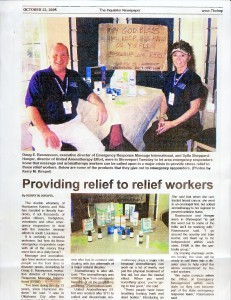
In 2001, after the tragedy of September 11th, I wanted to do something to help those affected. As a cancer survivor, I couldn’t donate blood, so I decided to join “Doug E.” and his team who were preparing to venture to New York to participate in the disaster relief. Before leaving, I had the idea to take some aromatherapy to help with the smell and other issues. Thanks to the internet, the call for donations from all my friends and colleagues in aromatherapy produced a miracle. On our first trip in November we carried $10K worth of supplies to give out. Doug E led us back 3 more times, with help from therapists from all over the USA and the REST-UK, the team formed by therapists in England.
After seeing such a drastic difference in the lives of those we were helping, because of the immense support we got, we decided to create the United Aromatherapy Effort, Inc.: a non-profit for collecting and disseminating aromatherapy products for first responders after disasters. Eileen Christina and I created the “Adopt a Station program” over bacon and eggs before our daily rounds. People sponsored a station and provided the funds to set them up. We were able to set up 23 NY firehouses with aromatherapy diffusers/vaporizers, blends, chest rubs and more.
Afterwards some of us also served in CERMT by helping Doug E break the world’s record for chair massage – 52 hours- in order to raise funds as we still had debt from NY! He did it and we paid off our debt!!

Afterwards some of us also served in CERMT by helping Doug E break the world’s record for chair massage – 52 hours- in order to raise funds as we still had debt from NY! He did it and we paid off our debt!!
After NY, we served in Biloxi after Hurricane Katrina for many weeks. Here we worked in the only building still standing with government officials. One department D-Mort in charge of bodies came over most days to get a massage to destress and scents for working in the field.
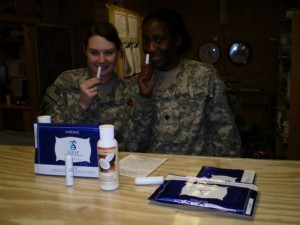
Our grand finale was supplying aromatherapy to the armed forces in Afghanistan. My nephew Jim Baucom was called to duty in Kabul and he helped us get the donations dispersed at Camp Phoenix by acting as our Soldier on the Ground, receiving and distributing supplies to other soldiers on duty.
For this great feat we got a flag flown over Camp Phoenix in our honor and this plaque, along with a letter from the General.
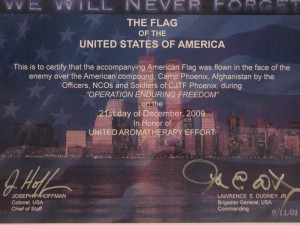
I’m so thankful for all those who helped us help others on our disaster relief missions. It is still hard to believe the small idea to take aromatherapy to New York became a successful non-profit organization lasting 20 years. Last year, we officially closed, but the UAE had a great run, having served two major disasters and many minor ones.